
Web Portal Development Company
Web Portal Development: Empower Your Business with Blazingcoders Web portals are now essential to the success of companies in all sectors in an era characterized by digital transformation. They ser
Read MoreSign Up Now and Get FREE CTO-level Consultation.
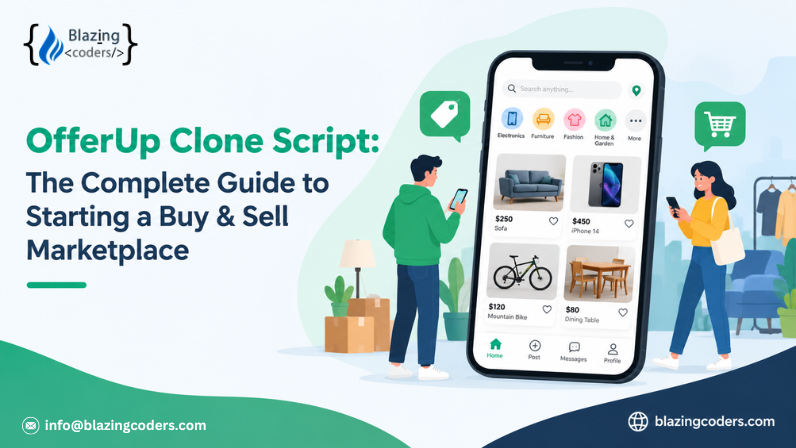
The rise of peer-to-peer marketplaces has transformed the way people buy and sell products online. Instead of relying only on traditional e-commerce stores, users can now list unwanted items, discover products nearby, communicate with buyers, and complete transactions through dedicated marketplace platforms. This growing demand has created exciting opportunities for entrepreneurs looking to launch their own buy-and-sell marketplace.
An OfferUp Clone provides a practical way to enter this market with a platform inspired by the core functionality of popular local marketplace apps. It allows entrepreneurs to create a feature-rich marketplace where users can list products, search for items, communicate with sellers, negotiate prices, and manage transactions.
This complete guide explains how an OfferUp-like marketplace works, its essential features, monetization opportunities, development process, and the factors to consider before launching your own platform.
An OfferUp Clone Script is a ready-made marketplace software solution designed to help entrepreneurs launch their own online buy-and-sell platform. It typically includes essential marketplace features for buyers, sellers, and administrators while allowing businesses to customize the platform according to their brand and target audience.
The concept is based on the peer-to-peer marketplace model. Sellers can create listings with product images, descriptions, prices, and location details. Buyers can browse categories, search for products, communicate with sellers, and make purchasing decisions.
Rather than developing every marketplace function from scratch, entrepreneurs can use a customizable clone solution as a starting point and adapt it to their business requirements.
The second-hand and local commerce market continues to attract consumers who want affordable products and convenient ways to sell unused items. A marketplace platform can connect buyers and sellers while generating revenue for the business owner.
An OfferUp Clone can be particularly useful for entrepreneurs who want to:
You can build a general marketplace for multiple product categories or focus on a particular niche such as electronics, furniture, automobiles, fashion, collectibles, or home appliances.
The marketplace generally involves three primary participants: buyers, sellers, and the administrator.
Sellers create accounts and publish product listings. They can upload images, add descriptions, set prices, specify locations, and manage their listings. Sellers can also respond to buyer inquiries and update product availability.
Buyers can register, browse categories, search for products, apply filters, view listing details, save interesting products, and communicate with sellers.
The administrator manages the entire marketplace through an admin dashboard. Admins can manage users, listings, categories, payments, reports, commissions, advertisements, and platform settings.
This three-sided structure creates a marketplace ecosystem where users interact with each other while the platform owner manages and monetizes the infrastructure.
The success of a marketplace depends heavily on its user experience and functionality. Your OfferUp Clone should include features that make buying and selling simple, secure, and convenient.
Allow users to create accounts using email, phone numbers, or social login options. User profiles can display basic information, listings, ratings, reviews, and other relevant details.
Sellers should be able to create detailed listings by adding product images, titles, descriptions, prices, categories, conditions, and locations.
A simple listing process encourages more sellers to publish products.
Buyers should be able to quickly find relevant products using keywords, categories, location, price range, product condition, and other filters.
Location-based search can be especially valuable for local marketplaces because buyers may prefer products available nearby.
Real-time messaging allows buyers and sellers to communicate without sharing personal contact information. Buyers can ask questions, negotiate prices, and arrange pickup or delivery.
Users can save products they are interested in and return to them later. This feature can improve engagement and encourage users to revisit the marketplace.
A rating and review system helps establish trust between marketplace participants. Buyers can review sellers, while sellers may also be able to rate buyers depending on the marketplace model.
Notifications can alert users about new messages, listing updates, offers, favorites, order changes, and promotional activities.
Location functionality allows users to discover products available within a specific radius. This is particularly important for a local buy-and-sell platform.
If your marketplace supports online transactions, integrate a reliable payment gateway. The platform can support different payment options depending on the target market.
The admin panel should provide centralized control over users, listings, categories, payments, commissions, advertisements, reports, and platform analytics.
Once the core marketplace is established, you can introduce advanced functionality to differentiate your platform.
Some useful additions include:
These features can be introduced gradually based on user demand and business requirements.
A marketplace can generate revenue in several ways. Choosing the right monetization strategy depends on your audience, market, and platform positioning.
You can charge sellers a percentage of successful transactions processed through the platform.
Sellers can pay to promote their products so they appear in prominent positions within search results or category pages.
Offer premium seller packages that provide additional listings, promotional tools, analytics, or other benefits.
Charge sellers a small fee when they publish certain types of listings or exceed a free listing limit.
Businesses can purchase advertising space to promote products and services to your marketplace audience.
Using multiple revenue streams can help create a sustainable business model rather than depending on a single source of income.
Developing a marketplace from the ground up can require considerable planning, development, testing, and maintenance. A ready-made solution can simplify the process.
A pre-built marketplace solution can reduce the time required to establish essential marketplace functionality.
You can customize branding, colors, layouts, features, categories, payment methods, and monetization options to align with your business model.
A properly developed platform can be expanded as the number of users, listings, and transactions increases.
Using an existing marketplace framework can reduce the amount of development work compared with building every feature independently.
A modern marketplace strategy can include web applications and mobile apps for Android and iOS, helping you reach users across different devices.
Building your marketplace requires more than simply installing software. You need a clear business strategy and a reliable technology foundation.
Determine whether you want to create a general marketplace or focus on a particular niche. Research your target users, competitors, product categories, and geographic market.
Decide how the platform will generate revenue. You can combine commissions, listing fees, subscriptions, featured listings, and advertising.
Identify the features required for your initial launch. Focus on functionality that directly supports buying and selling before adding complex features.
Customize the marketplace according to your brand identity. This can include the logo, colors, user interface, categories, payment options, and marketplace rules.
If transactions happen through the platform, integrate suitable payment solutions. Add push notifications and messaging to improve communication.
Conduct functional, security, performance, and usability testing before launch. Test the buying and selling processes from both user perspectives.
Start with a specific market or location if appropriate. Use social media marketing, search engine optimization, referral campaigns, partnerships, and promotional offers to attract initial users.
After launch, monitor user behavior, listings, transactions, retention, and feedback. Use this information to improve features and expand into new markets.
The cost of developing an OfferUp Clone depends on several factors. These include the number of platforms, feature complexity, customization requirements, integrations, UI/UX design, security requirements, and development approach.
A basic marketplace with essential listing and communication features will generally require less investment than an advanced platform with AI recommendations, sophisticated payment workflows, delivery integration, identity verification, and extensive analytics.
Instead of focusing only on the initial development price, consider the long-term cost of hosting, maintenance, security updates, third-party integrations, marketing, and customer support.
Technology is only one part of a successful marketplace. You also need to build trust and create enough activity to keep buyers and sellers engaged.
Start by focusing on a specific audience or geographic area. A smaller marketplace with active users can be more valuable than a large marketplace with very few listings.
Make product discovery simple, keep the listing process quick, and provide effective communication tools. Strong moderation and reporting mechanisms can also help reduce spam, scams, and inappropriate content.
You should also develop clear policies covering prohibited products, payments, disputes, refunds, user behavior, and account violations.
Most importantly, continuously collect feedback from users and use it to improve the marketplace experience.
Launching a peer-to-peer marketplace can be an attractive opportunity for entrepreneurs who want to participate in the growing online resale and local commerce industry. An OfferUp Clone can provide the foundation needed to create a platform where buyers and sellers can connect, communicate, and conduct transactions.
From user registration and product listings to advanced search, chat, payments, ratings, notifications, and admin management, the right feature set can create a convenient marketplace experience.
However, successful marketplace development is not just about copying an existing concept. Your platform should offer a clear value proposition, reliable technology, strong security, effective monetization, and an excellent user experience.
Whether you plan to build a local marketplace, a niche resale platform, or a large multi-category marketplace, choosing a customizable OfferUp Clone Script can help you establish the foundation for your business and scale it as your audience grows.
Request a FREE Business Plan.
 +91 ▼
+91 ▼ 
Web Portal Development: Empower Your Business with Blazingcoders Web portals are now essential to the success of companies in all sectors in an era characterized by digital transformation. They ser
Read More
Building database-driven web applications becomes much easier when you understand the CRUD pattern. CRUD stands for Create, Read, Update, and Delete—the four basic operations used to manage reco
Read More
WordPress is a popular platform for building websites due to its flexibility and ease of use. However, like any other platform, it’s not without occasional technical hiccups. One common problem
Read More